 EN
EN
- Overview
- FAQ
- Recommended Products
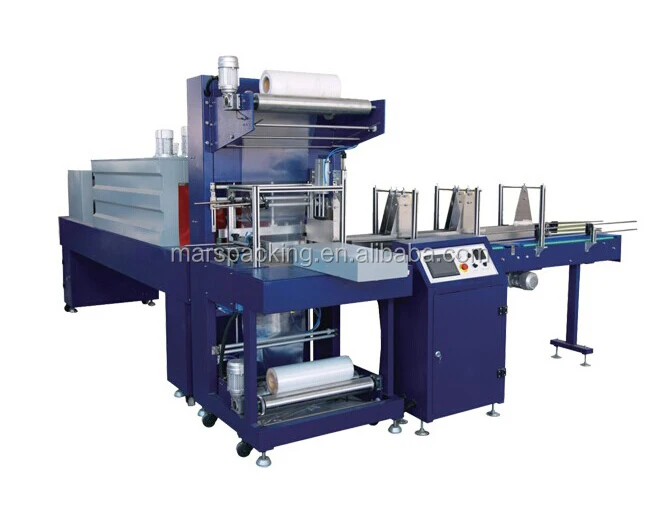
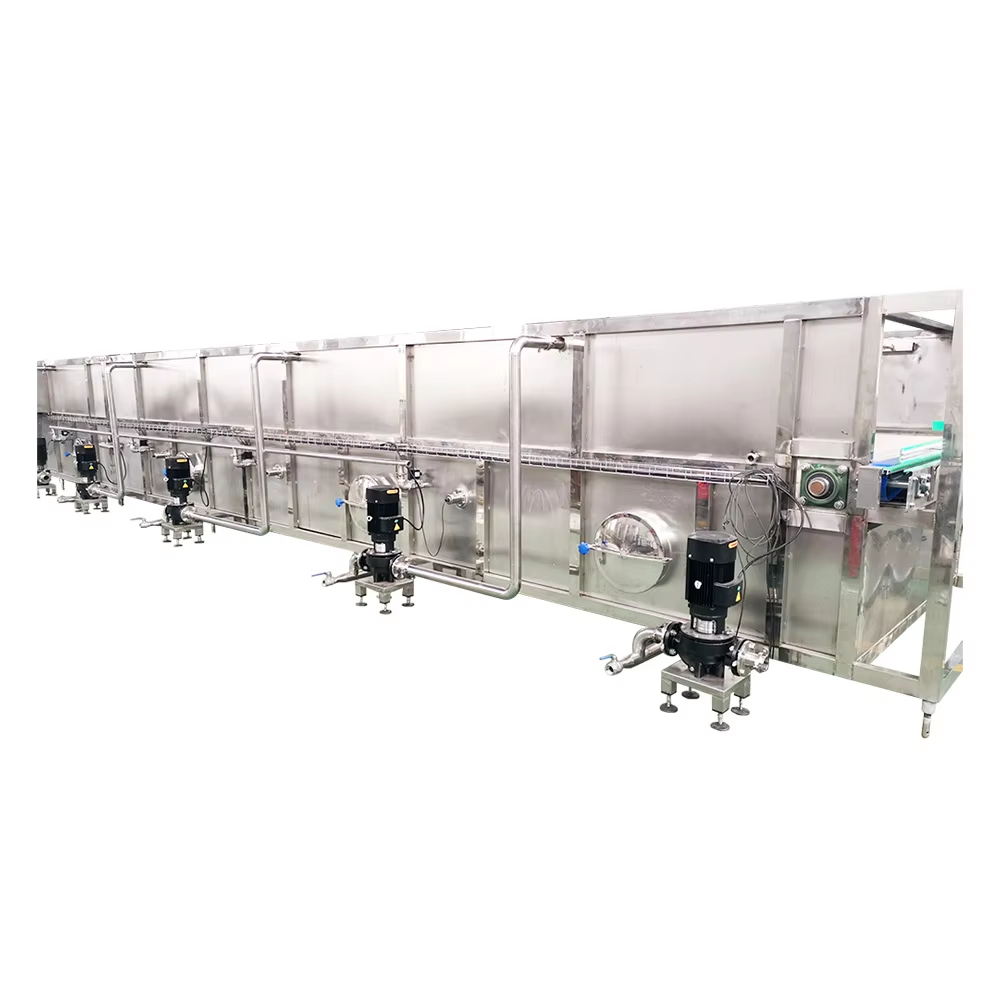
Introducing, the Mars On Line Water Spray Bottle Cooling Tunnel/Warmer, the perfect solution for all your temperature control needs. This innovative product is designed to efficiently cool or warm bottles with a simple spray of water, saving you time and hassle.
With the On Line Water Spray Bottle Cooling Tunnel/Warmer, you can easily adjust the temperature of your bottles to suit your preferences. Whether you need to cool down a refreshing beverage on a hot day or warm up a soothing drink in the winter, this versatile device has got you covered.
The Mars brand is known for its high-quality products, and the On Line Water Spray Bottle Cooling Tunnel/Warmer is no exception. Made with durable materials and advanced technology, this cooling tunnel/warmer is built to last and provide reliable performance for years to come.
Using the On Line Water Spray Bottle Cooling Tunnel/Warmer is a breeze. Simply place your bottle in the tunnel, push a button to activate the spray, and watch as the temperature quickly adjusts to your desired setting. With a sleek and user-friendly design, this product is perfect for home use or commercial applications.
Whether you're a busy mom looking to quickly cool down a bottle of milk for your little one, a student needing a refreshing drink after a workout, or a business owner in need of a reliable way to keep beverages at the perfect temperature, the Mars On Line Water Spray Bottle Cooling Tunnel/Warmer is the ideal solution.
Don't let warm drinks or cold beverages ruin your day. Invest in the Mars On Line Water Spray Bottle Cooling Tunnel/Warmer and enjoy the convenience of perfectly temperature-controlled bottles whenever you need them. Order yours today and experience the convenience and efficiency of this innovative product
On Line Water Spray Bottle Cooling Tunnel/Warmer for Sale
General Descriptions
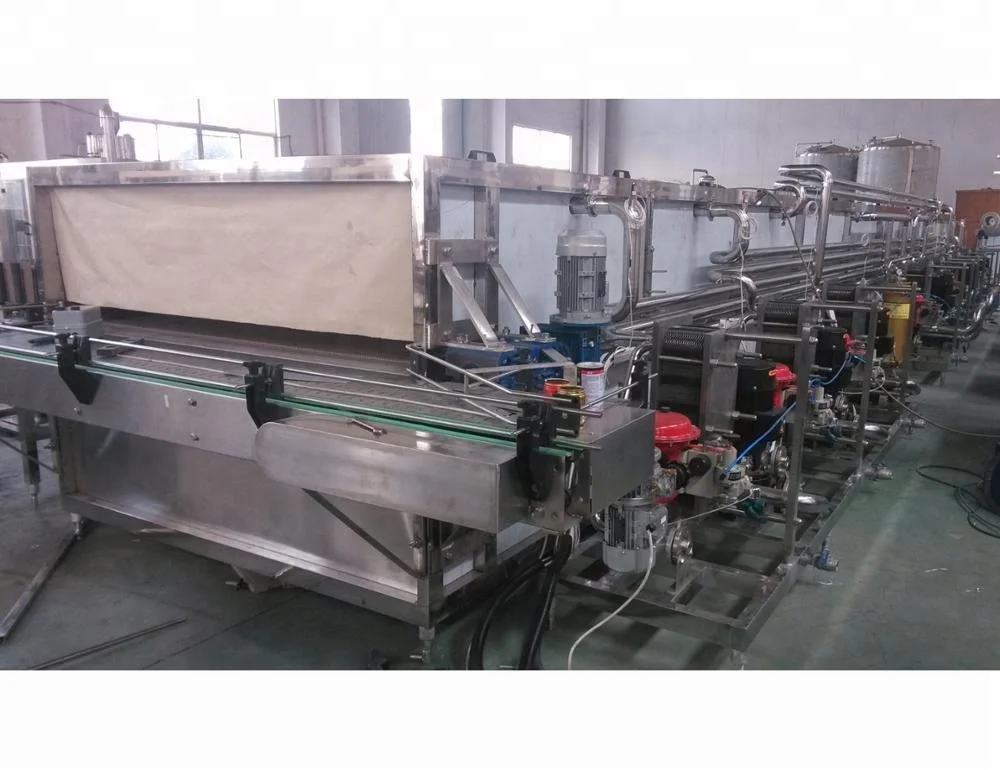
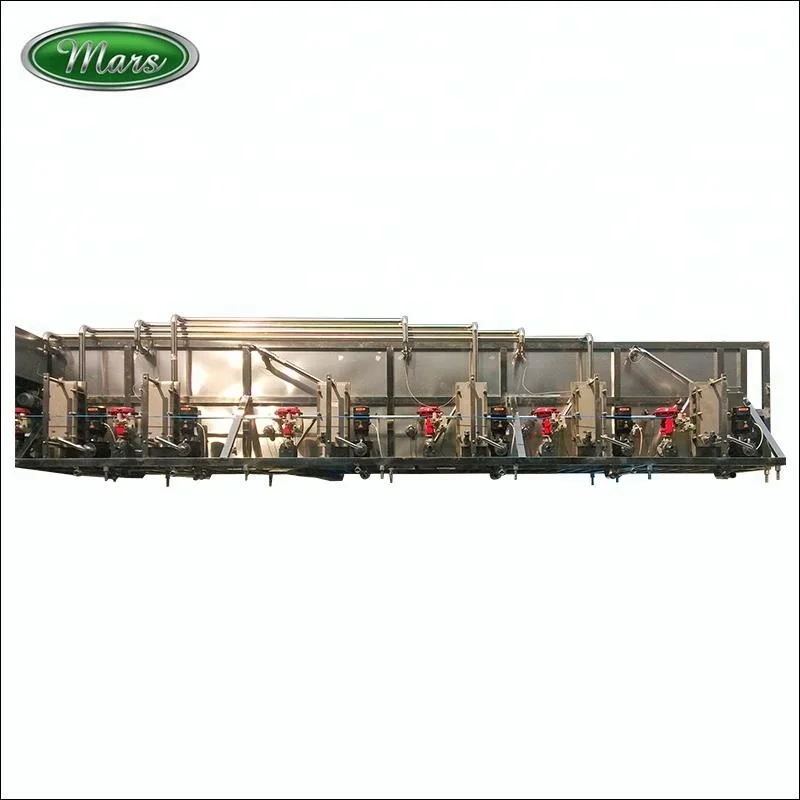
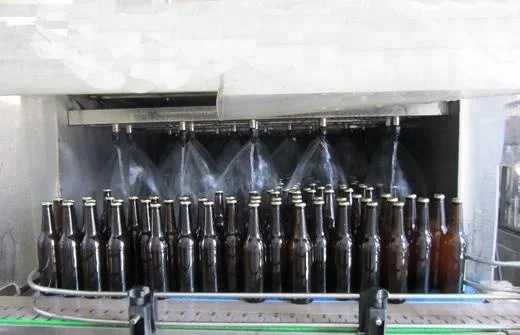
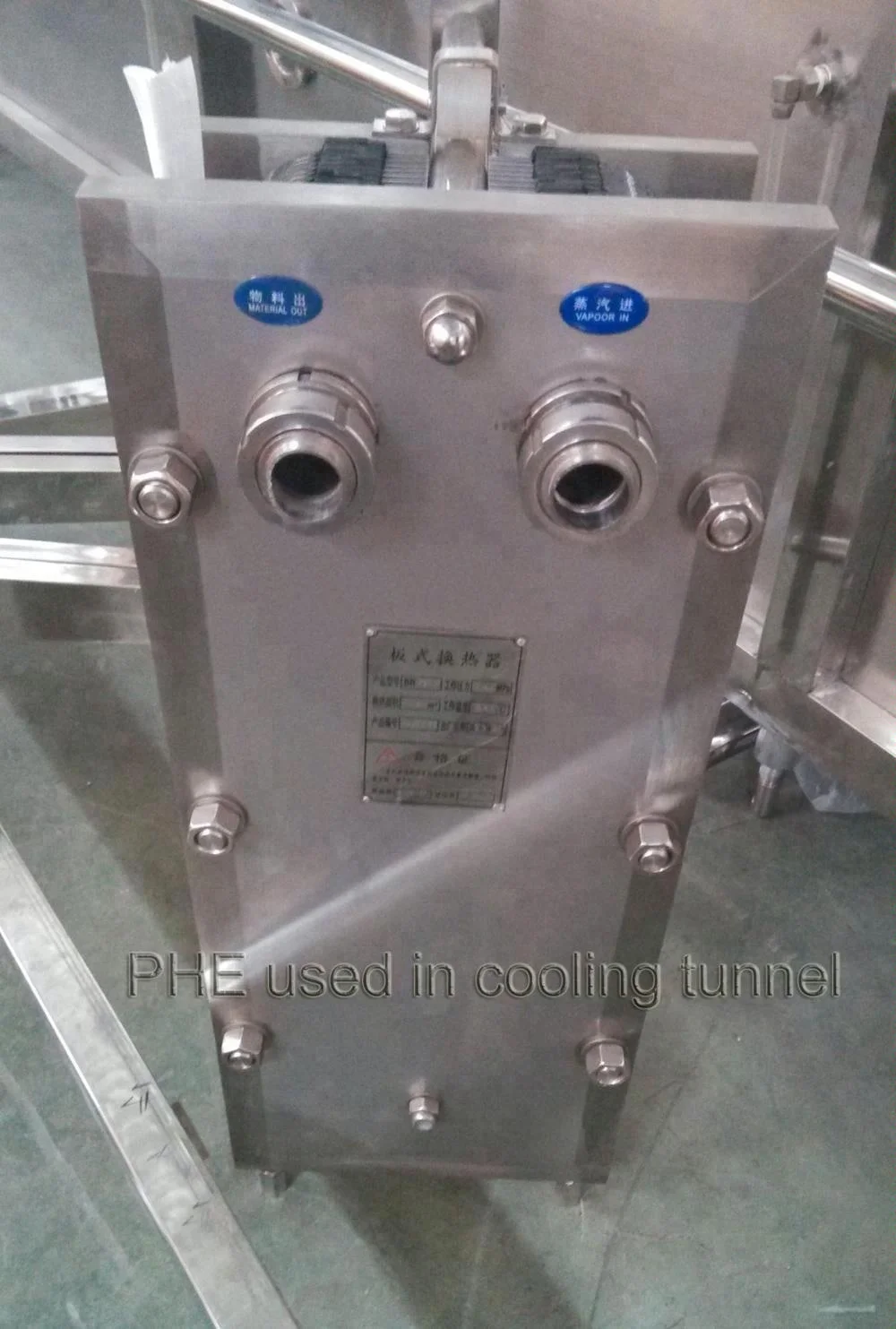
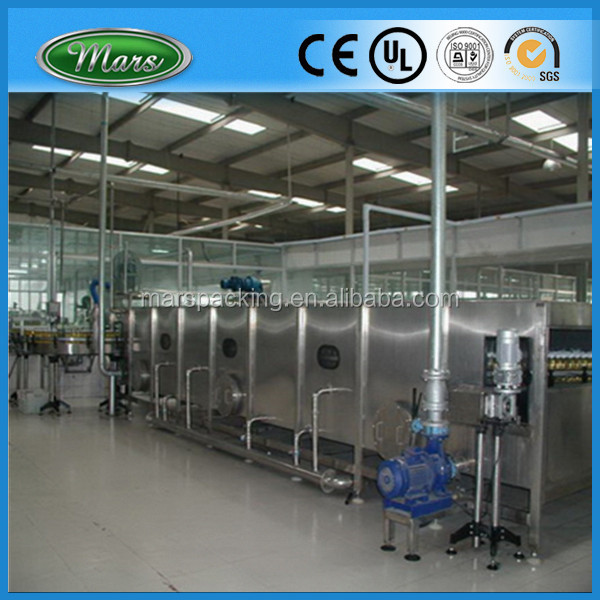
Based on the advanced technology from Germany, Italy, and Taiwan, we developed this new type of bottle cooling machine. Its working-process can be divided into three stages: circulating hot-water spray-cooling, warm-water pre-cooling and cold-water cooling. The cooling-heating temperature can be regulated according to the requirements of the user. It is suitable for cooling and heating all kinds of bottled or canned hot beverage or carbonated beverage. It is equipped high temperature-resistant polypropylene (CPP) chain. This machine is made of SUS304 stainless steel and it is reliable in running and has beautiful appearance
This machine is absorbed the abroad equipment technology and newly-designed, using circular cooling water in five cooling section to cool the fulfilled bottle step by step. During cooling, it will accords to customer's requirement to adjust speed by inverter, which is suitable for cooling of all kinds of hot material
Main features
1. The whole body is made from stainless steel (horse, bearing, engine excluded), observing window can be set to around the base, the top structure can be opened for easy maintaining.
2. The recycling filtering device and alarming system is equipped to the water gathering slot in the cooling tunnel.
3. Fringe board is heat-endurable net fringe flat and abrasion-endurable.
4. Overload protecting device in the main engine to protect fringe board and conveyor system effectively.
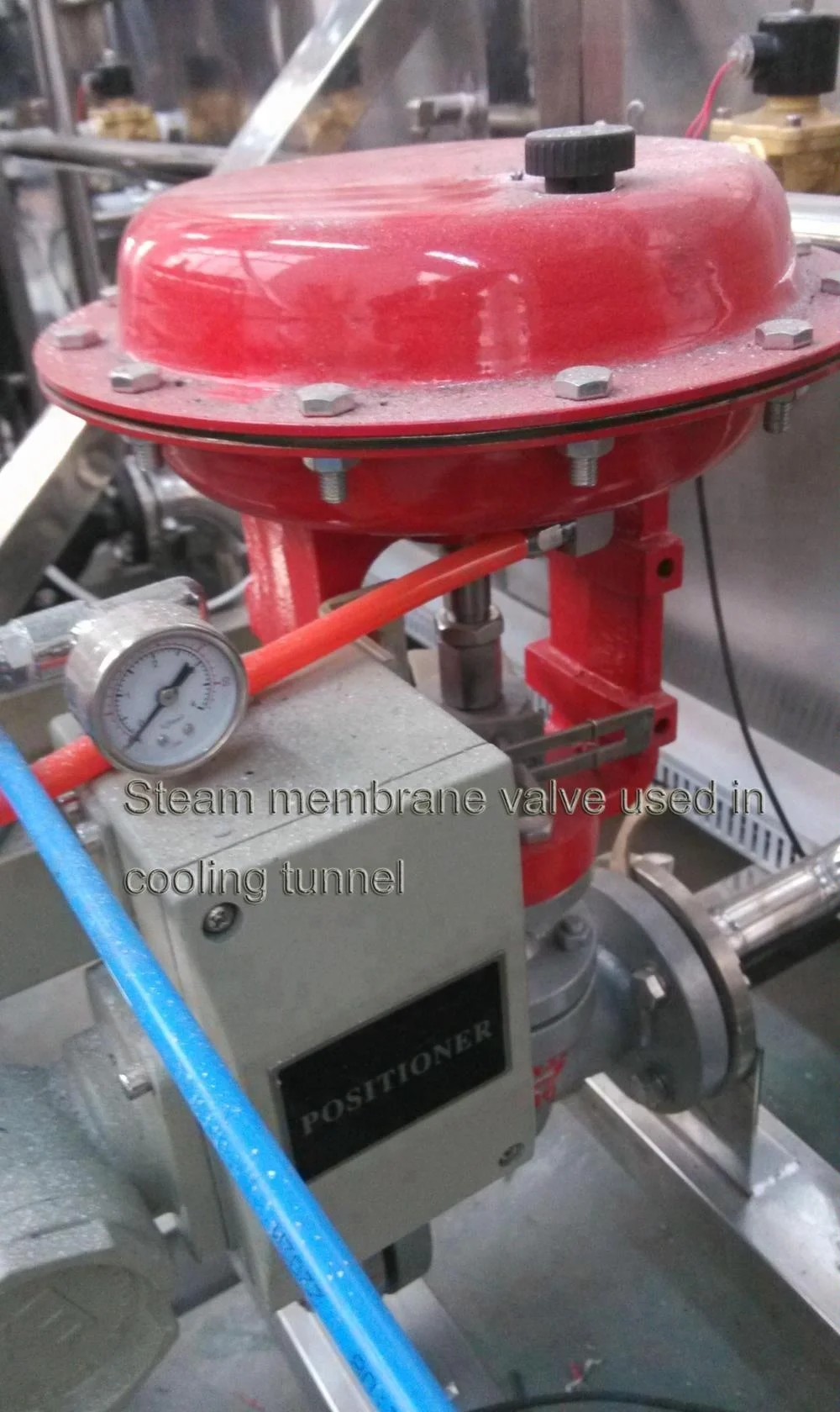
5. Thermometer and water pressure meter also equipped
6. Spraying recycling water pump and antiseptics pump equipped.
7. Branch spraying pipes can be disassembled for easy rinsing
8. Using uniform spraying supplement, in the first zone, to prevent water temperature change fiercely
Main Technical Parameter:
Model |
PL-1 |
Rated Capacity |
6000-7000B/Hour - 500ml |
Tunnel length |
8M |
Chain width |
1.2M |
Efficient Area |
8m2 |
Main Conveyor Speed |
233.25 mm/minute |
Bottle Entrance Temperature |
80-85°C |
Bottle Exit Temperature |
30-40°C |
Total Time From Entrance to Exit |
20 minutes - speed adjustable |
Max. Diameter of Bottle |
120mm |
Max. Height of Bottle |
340mm |
Cooling Medium |
Water Pressure: 2-4Kgf/cm2 |
Temperature processing area |
3 phases |
Water recycle capacity |
10m3/hour |
Water Consumption |
≤0.3m3/h |
Main motor power |
1.1Kw |
Total Power |
10.29KW |
Dimension Size |
8000*1400*1650 |
Total Weight |
3500Kg |
Product show
1. MARS company can provide one stop service including whole factory design, product solution design, abroad installation, worker training, spare parts supply etc.
2. MARS company have professional design team, our engineer can draw bottle samples and flow chart of
workshop for you
3. MARS company give you the best quotation for all kinds of beverage production, only you can tell me which
kind of drink you want to product, what is your capacity(how many bottles one hour) what is you bottle
material, pet or glass, etc
After service:
1. We send the engineers to help installing, commissioning and training, the engineers start from our factory area.
2. We supply below necessary documents with the machine:
a. Machine layout
b. Electricity diagram
c. Machine certificate
d. General operation manual/maintenance book
3. After two year guarantee, the seller provides payable spare parts and technician’s VISITING maintenance
service.
|
Q1 What is the difference between hot filling and cold aseptic filling for juice — which do you recommend and why? |
Choosing the right filling technology is the most critical decision for your juice production line. It directly impacts your product's taste, shelf life, packaging costs, and logistics. The Core Technical Difference Hot Fill: hot filling is typically means filling temperature from 85°C to 95°C. in this way both the juice/tea and bottle are sterilized simultaneously. The bottle must withstand this heat without deforming. The bottle material cost is higher. But machine production line invest is lower. Cold Aseptic Filling: the bottle, cap, and the environment separately sterilized(using steam or chemicals), then fill the bottle with a sterile, chilled product. The total invest is high. But bottle material is lower and can keep drink fresh taste well. |
|
Q2 Can this line handle juices with pulp or fiber content, or is it only for clear juice? |
This line is specifically designed for clear juice (e.g., apple, grape, clarified juice). It is not recommended for high-pulp or high-fiber juices such as orange, tomato, or smoothies, as pulp may cause clogging. For pulp-containing juices, we have special machine for it. |
|
Q3 What sterilization method do you use — UHT, HTST, or tunnel pasteurizer? |
1. UHT (Ultra-High Temperature) – Best for Aseptic Filling Process: 135–150°C (275–302°F) for 2–5 seconds. Application: Milk, plant-based beverages, dairy desserts, liquid eggs. Advantage: Enables ambient storage (6–12 months) without refrigeration.
Equipment: Plate or tubular UHT sterilizer + aseptic filling system. 2. HTST (High-Temperature Short-Time) – Best for Chained Distribution Process: 72–85°C (161–185°F) for 15–30 seconds. Application: Fresh milk, juice, beer, ice cream mix. Advantage: Better preserves flavor & nutrients; lower energy cost. Shelf life: 2–6 weeks refrigerated. 3. Tunnel Pasteurizer – It is after filling pasteurizing. Process: Multi-zone spray (preheat → pasteurization → cooling) at 60–98°C. Application: Beer, cider, canned vegetables, pet food pouches, glass jars. Advantage: Post-packaging sterilization; no aseptic filler required. |
|
Q4 Does the line include a liquid nitrogen dosing system? What is the purpose of nitrogen injection in juice filling? |
Yes, we offer an optional liquid nitrogen dosing system (LND) integrated with our filling lines — particularly for PET bottling water, juice, edible oil, non-carbonated drink can filling. Liquid nitrogen (LN₂) dosing serves two critical purposes in juice and beverage filling: 1. Oxygen displacement – Extend shelf life & preserve quality A small drop of LN₂ vaporizes inside the container headspace before sealing. The expanding nitrogen gas pushes out oxygen (the main cause of oxidation, vitamin C loss, and color fading). Result: Reduced dissolved oxygen (DO) → longer shelf life without adding preservatives. 2. Rigidity & stackability – Prevent paneling (for PET bottles) Juice-filled PET bottles often collapse inward during cooling (vacuum effect). LN₂ dosing adds a controlled internal pressure (1.5–3 bar) after capping.
Result: Bottles remain rigid, lightweight, and stackable for palletizing — no need for thicker plastic or vacuum panels. For hot-fill juices: LN₂ replaces expensive vacuum panels or nitrogen flushing systems. |
|
Q5 What bottle materials are supported — PET only, or also glass and HDPE? |
For hot-filling machines, supported bottle materials typically include PET, glass, and HDPE, depending on the machine design and filling temperature. PET: Suitable for hot-filling only with heat-set (crystallized) PET; standard PET cannot withstand high temperatures above 60°C. Glass:Fully compatible with most hot-filling applications (juice, tea, etc.) due to excellent thermal resistance. HDPE:Limited compatibility — only high-density polyethylene grades with high thermal stability (some up to 90–95°C) can be used for hot-filling. standard HDPE may deform |
|
Q6 What is the filling temperature range for hot-fill juice products? |
Hot-fill juice products typically have a filling temperature range of 80°C to 95°C (176°F to 203°F).
For optimal sterilization of the container and cap, most hot-fill applications target 88°C to 92°C (190°F to 198°F). The minimum temperature required to achieve commercial sterility without preservatives is generally 80°C (176°F). |
|
Q7 How do you ensure the juice does not oxidize or change color during the filling process? |
1. Minimize Oxygen Exposure Use a fully enclosed filling system with inert gas flushing (e.g., nitrogen) to displace oxygen from the filling chamber and containers before and after filling. Install a deaerator before filling to remove dissolved oxygen from the juice prior to heating.
2. Control Temperature & Time Maintain a high filling temperature (80–95°C) for hot-fill, which sterilizes and reduces oxygen solubility. Reduce product hold time between deaeration and sealing to limit oxidative reactions.
3. Optimize Equipment Design Apply sanitary, low-shear valves and pumps to prevent air entrainment. Use variable frequency drives to avoid excessive turbulence during filling. Ensure splash-free filling nozzles to minimize foam and oxidation.
4. Add Antioxidants (if permitted) Include ascorbic acid, erythorbic acid, or rosemary extract to inhibit enzymatic and non-enzymatic browning.
5. Bottle & Seal Integrity Pre-heat containers to reduce thermal shock and condensation, which can trap oxygen.
Apply immediate capping after filling (≤2 seconds) with steam or nitrogen cap flushing.
Use oxygen-scavenging caps or liners for long-term color stability.
6. Cleaning & Maintenance Regularly check for leaks in seals, gaskets, and pipe connections.
Clean filler bowls and nozzles to avoid caramelized juice residue (which promotes discoloration).1. Minimize Oxygen Exposure |
|
Q8 What is the shelf life we can expect for juice products filled on your line without refrigeration? |
For hot-fill juice line, the expected shelf life without refrigeration typically ranges from 6 to 12 months, depending on product acidity (pH < 4.2), filling temperature (≥80°C–95°C), bottle and cap sterilization, and barrier properties of the packaging material. |
|
Q9 Can the same line be used for both still juice and carbonated juice drinks? |
No, the normal hot filling line can be used for both still (non-carbonated) juice only, for carbonated juice drinks, it need isobaric pressure filling machine. |
|
Q10 What food safety standards does your juice line comply with (FDA, CE, ISO 22000, etc.)? |
Our juice production line complies with CE (Conformité Européenne) for machinery safety and electromagnetic compatibility, and ISO 22000 for food safety management systems. For hot filling machines specifically, we also follow cGMP (Current Good Manufacturing Practices) and HACCP (Hazard Analysis Critical Control Points) principles to ensure microbiological safety, seal integrity, and thermal processing compliance. |